
Criminal Court Cases in San Augustine County
San Augustine County criminal court cases are divided by jurisdiction. The District Clerk keeps felony files for the 1st and 273rd Judicial District Courts. The constitutional County Court, reached through the County Clerk, handles applicable Class A and Class B misdemeanors and lower-court appeals. The Justice Court and San Augustine Municipal Court keep fine-only matters that arise within their own authority. San Augustine County has no county court at law, so the constitutional County Court remains a key stop for misdemeanor court records.
Each clerk maintains the cause-numbered record for that court. A case file can hold the complaint, information or indictment, docket entries, settings, motions, orders, judgment, sentence, bond entries, attorney information, and court costs. The arresting agency does not maintain that full filed record. The prosecutor may have a working file, but filed pleadings and the final court outcome belong with the clerk.
San Augustine County Court Jurisdictions
The fastest court case search begins by sorting the alleged offense. A felony belongs at the San Augustine County District Clerk. An applicable Class A or B misdemeanor points to the County Clerk. A precinct fine-only case or related warrant can remain with Justice Court, while a city ordinance or other fine-only city charge can remain with Municipal Court. The issuing court matters because the same name can appear in more than one court index.
| Criminal venue | Records held | Verified contact |
|---|---|---|
| 1st and 273rd District Courts | Felony filings and district criminal proceedings | District Clerk, 936-275-2231 |
| Constitutional County Court | Applicable Class A/B misdemeanors and lower-court appeals | County Clerk, 936-275-2452 |
| Justice Court | Precinct fine-only cases and warrants | 936-275-3552 |
| San Augustine Municipal Court | City ordinance and fine-only city cases | 936-275-2121 |
This local split is more dependable than sending one broad request to the justice campus. Ask which court owns the cause before paying for a copy.
San Augustine County Case Record Searches
No verified San Augustine County criminal case-search portal was found. re:SearchTX can serve as a preliminary statewide index, but the Texas Judicial Council has documented a major criminal-record coverage limit. A blank result is not proof that no San Augustine County case exists. The reliable path is a direct search or copy request to the clerk with jurisdiction.
- Choose the likely court from the charge level, issuing agency, and location. If uncertain, call the clerk before sending a request.
- Give the full legal name, approximate filing or arrest year, court, and cause number if known. Ask whether another identifier may be used to separate similar names.
- Request a precise item, such as the docket sheet, charging instrument, order, judgment and sentence, or the whole available case file.
- Ask whether the San Augustine County record is electronic, paper, archived, sealed, or otherwise restricted. Confirm any search, retrieval, copy, and certification charge before work begins.
- Order a plain copy for review or a certified copy when proof from the custodian is needed. Verify the accepted request, delivery, and payment method with that clerk.
These details help both a counter search and an initial re:SearchTX check:
| Search detail | Use | Required | San Augustine County note |
|---|---|---|---|
| Full legal name | Name search | Usually | Include prior legal spelling when relevant |
| Cause number | Direct file match | No | Best way to avoid a same-name mix-up |
| Approximate year | Index or archive range | No | Helps staff narrow paper and older records |
| Court or charge level | Jurisdiction routing | No | Separates district, county, justice, and municipal files |
| Document needed | Copy request | No | Name the docket, order, judgment, or sentence |
A clerk search may be started by phone or at the counter, while mail, email, and fax can support a copy request when the receiving office permits them. San Augustine County has not posted one criminal-copy price or archive schedule across all four venues, so confirm the method, fee, payment type, and completion time with the specific clerk.
San Augustine County Criminal Files
The San Augustine County District Clerk is the registrar, recorder, and custodian of pleadings and papers in both district courts. The public counter is in the San Augustine County Courthouse at 100 W Columbia, Room 202, San Augustine, TX 75972. It is open Monday through Thursday from 8 a.m. to 4 p.m. and Friday from 8 a.m. to 3 p.m. The office number is 936-275-2231, the fax is 936-275-2389, and the email is distclerk@co.san-augustine.tx.us.
District Clerk Criminal Counter
100 W Columbia, Room 202
San Augustine, TX 75972
936-275-2231
Mon-Thu 8 a.m.-4 p.m.; Fri 8 a.m.-3 p.m.
The official local district-court listing shows the offices that serve San Augustine County.
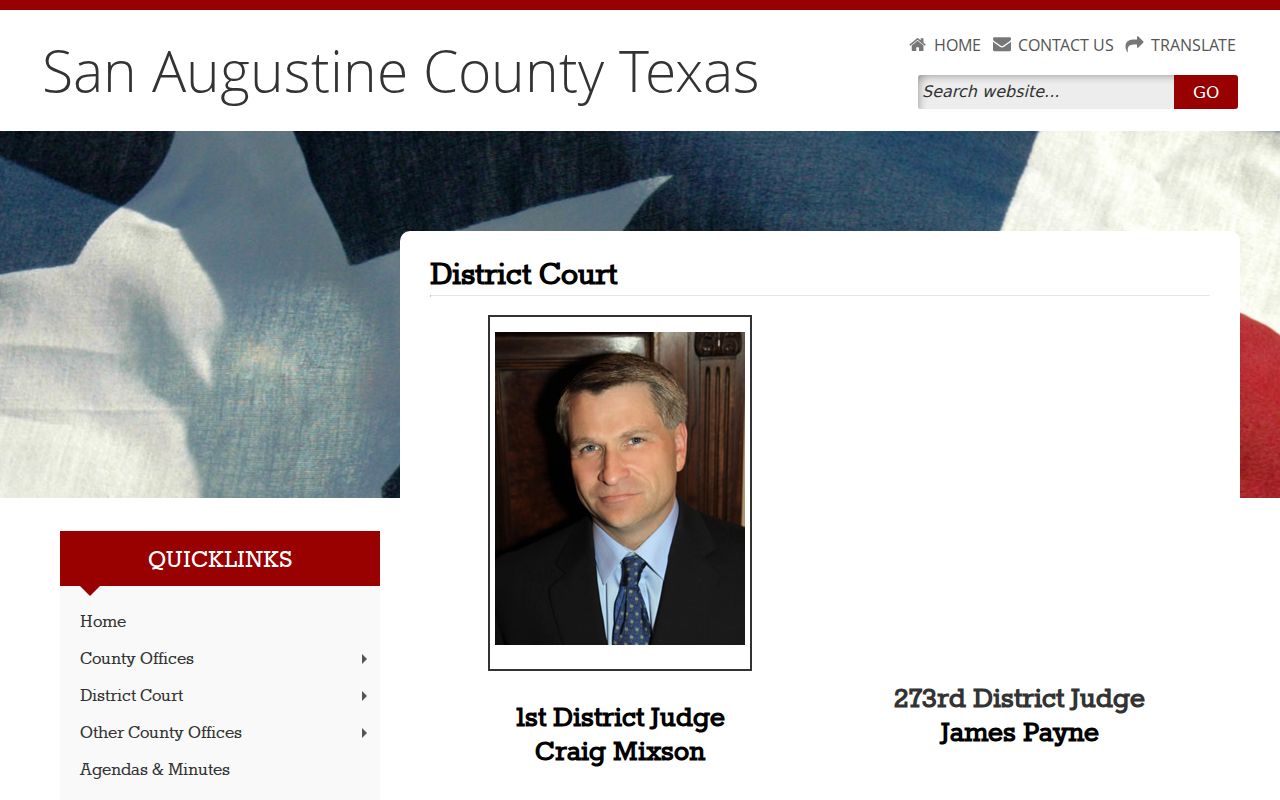
The image helps confirm that local felony case records are tied to named district courts while the District Clerk remains the file custodian.
What a Criminal Case File Contains
A San Augustine County court file tracks what was formally filed and what the judge decided. It should not be confused with an arrest report or jail booking entry. Intake charges can change when a prosecutor screens the referral. For the clearest outcome, request the charging instrument and the final judgment or order, then use the docket to see the events between those points.
| Cause Number and Court | The unique local case reference and the district, county, justice, or municipal venue. |
|---|---|
| Charging Document | The complaint, information, or indictment that states the filed charge. |
| Docket Entries | The case-event register, including filings, settings, motions, and orders. |
| Hearings and Bond | Scheduled court events and bond information when recorded in the file. |
| Disposition and Judgment | The authoritative outcome, such as dismissal, acquittal, conviction, or deferred adjudication. |
| Sentence and Costs | The punishment, community supervision, fine, confinement, and financial entries ordered by the court; the Texas Penal Code ranges show possible class limits rather than the actual judgment. |
Exact public fields can vary because San Augustine County did not provide an accessible sample criminal file. Ask for the named document instead of assuming every field is online.
San Augustine County Court Outcomes
Court words describe different results. A dismissal ends a charge without a guilt judgment. An acquittal is a not-guilty result. A conviction is a judgment of guilt. Deferred adjudication postpones a guilt finding during supervision and is not an ordinary final conviction if completed, though it may still appear in the public DPS product unless lawfully restricted.
- Docket
- The dated register of events in a San Augustine County case.
- Disposition
- The recorded outcome of a charge or case.
- Information
- A prosecutor's charging paper, commonly used for a misdemeanor.
- Indictment
- A grand-jury felony charge filed with the court.
- Judgment
- The court's formal record of the result and sentence.
Neither dismissal nor acquittal automatically erases the arrest or booking index. The certified order is the best source for the actual case result.
Criminal Case Stages in San Augustine County
A San Augustine County case can begin with an arrest, followed by magistration without needless delay and no later than 48 hours. The magistrate gives required warnings, addresses the counsel process, and considers bail. A prosecutor then decides what to file. A felony may proceed through a grand jury, while the charging path differs for misdemeanor and fine-only matters.
Case flow: Charges Filed › Arraignment › Pretrial › Plea or Trial › Disposition › Sentencing
Discovery, motions, plea talks, and hearings may appear between arraignment and disposition. Post-judgment motions or an appeal can follow. The docket gives the sequence, but the judgment and sentence state the court's final action at that stage.
Archived San Augustine County Case Records
A no-result screen does not rule out an older local case. The file may be paper, archived, indexed under another legal spelling, maintained by a lower court, or outside the participating coverage of a statewide tool. Give the clerk a narrow year range, cause number when available, and the court that likely heard the charge. Then ask whether archive retrieval changes the time or cost.
No official local criminal-copy fee or archive schedule was found in the research. Request an itemized estimate before authorizing a large search or copy order. Also state whether a plain copy will serve the need. Certification should be requested from the custodian when a formally authenticated judgment or order is required.
Note: A statewide portal gap is not a finding that no San Augustine County criminal court record exists.
Access Rules for Case Records
The Texas Public Information Act treats filed court records as public unless another law makes them confidential. That principle does not open every fact in every San Augustine County file. Juvenile material, sealed and nondisclosed records, protected victim information, and private identifiers may be closed or redacted. Grand-jury deliberations also are not the same as a filed indictment.
Law-enforcement and prosecutor working material may face different disclosure rules from filed court papers. Government Code Section 552.108 can apply to active law-enforcement or prosecution records, while the public judgment remains a clerk record. An online view may omit information that is available in a properly redacted counter copy.
San Augustine County Court and Prosecutor Files
The District Attorney works in Room 302 of the courthouse, but the District Clerk keeps filed criminal cases in Room 202. Prosecutors receive referrals, decide charges, present suitable felonies to a grand jury, and litigate cases. Their file is not a substitute for the public court docket, filed charge, judgment, or sentence.
The official District Attorney page shows the separate prosecutor office.
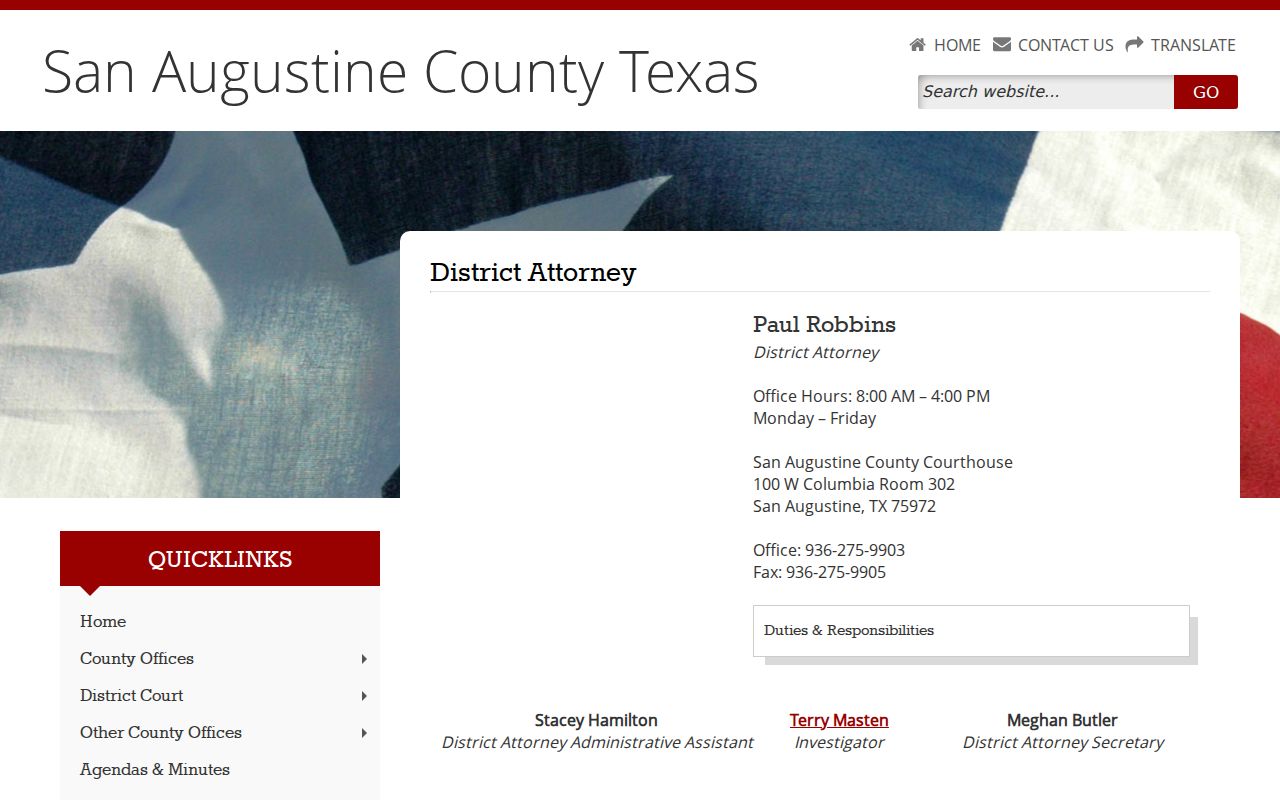
The office location makes the local distinction concrete: request filed criminal court records from the clerk one floor area away, not from the prosecution team.
There also is no verified general walk-in public defender counter in San Augustine County. A court decides indigence and appoints qualified counsel under the county's adopted plan. The Texas Indigent Defense Commission plan viewer is the official route to that plan. The District Attorney is never the defense contact.